
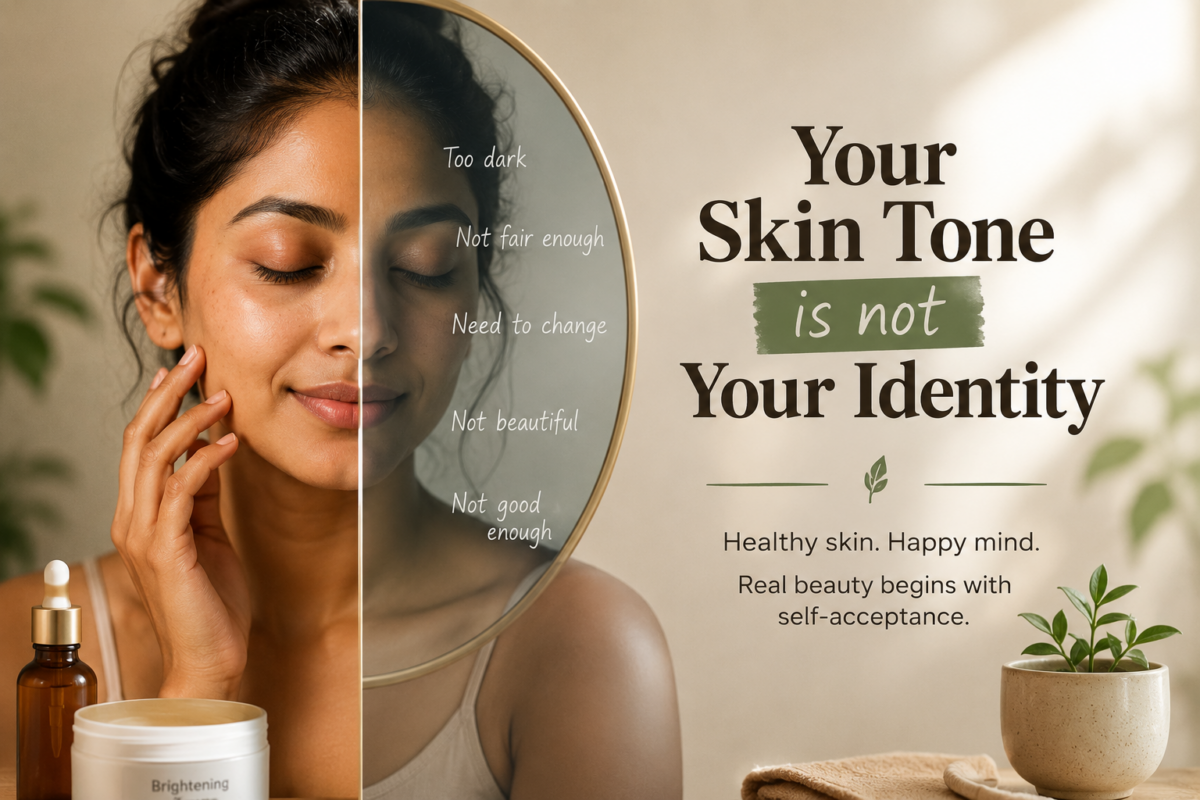
When Skin Lightening Becomes More Than Skincare
For many people, skincare begins with a simple intention:
I want my skin to look and feel healthy.
But somewhere along the way, that simple intention can become something else.
A dark spot becomes something that must disappear.
Uneven skin becomes something to hide.
And eventually, a person’s natural skin tone itself can start feeling like a problem that needs to be changed.
This is where we need to have a more honest conversation about skin lightening, beauty standards and the way we see ourselves.
Because taking care of your skin and trying to change who you are are not necessarily the same thing.
Your Skin Tone Is Not Something That Needs to Be Fixed
Skin comes in many different shades.
Some people are naturally very fair.
Some have medium or olive complexions.
Some have deeper skin tones.
All of these are normal.
Your skin tone is influenced by genetics and melanin, and it can also change in appearance because of sun exposure, hormones, age and certain skin conditions.
Yet beauty culture has often attached ideas of attractiveness, success and social acceptance to lighter skin.
Those messages can be powerful.
They appear in advertisements.
They appear in social media.
They appear in casual comments from people around us.
And after hearing them repeatedly, it is easy to start believing that something perfectly natural about us needs to be corrected.
It doesn’t.
Treating Pigmentation Is Different From Trying to Become Lighter
There is an important difference between treating a skin concern and trying to change your natural complexion.
Someone may want to reduce:
- Acne marks
- Melasma
- Sun-related pigmentation
- Uneven skin tone
- Dark patches caused by inflammation or another skin condition
These can be legitimate skincare concerns.
But the goal should be to understand why the pigmentation is happening rather than simply applying increasingly stronger lightening products.
Pigmentation can have different causes, and treating the wrong cause can sometimes make the problem worse.
That is why persistent or unusual pigmentation is worth discussing with a dermatologist rather than experimenting endlessly with products.
Be Careful With Products That Promise Too Much
The skincare market is full of dramatic promises.
“Fairer skin.”
“Instant whitening.”
“Seven-day transformation.”
“Permanent results.”
The more unrealistic the promise, the more carefully you should look at the product.
Some skin-lightening products have been found to contain harmful ingredients, including undeclared mercury. Repeated exposure to mercury through certain cosmetic products can cause serious health problems. Unsafe or improperly used ingredients can also damage the skin itself.
So before using a product, ask yourself:
Do I know exactly what is in it?
Is the product properly labeled?
Is it coming from a trustworthy source?
Is it actually designed for the skin concern I have?
And am I using it because I want healthier skin—or because I have started believing that my natural skin tone isn’t good enough?
That last question may be more important than it seems.
Stronger Does Not Always Mean Better
When a skincare product doesn’t produce the result someone wants, the temptation is often to move to something stronger.
Then stronger again.
And again.
But irritated skin can develop more pigmentation, particularly when the skin’s protective barrier is being repeatedly disturbed.
Gentle, fragrance-free skincare can be a better starting point for many people dealing with pigmentation, while appropriate treatment should be selected according to the cause and skin type.
Skincare isn’t a race.
Your skin needs time.
Sun Protection Is One of the Most Important Steps
If pigmentation is your concern, ignoring the sun while constantly buying brightening products is like trying to empty a bucket without closing the tap.
Sun exposure can worsen pigmentation and melasma.
Dermatologists generally recommend broad-spectrum sunscreen with SPF 30 or higher, along with other forms of sun protection such as shade, protective clothing and hats. For people concerned about pigmentation, a tinted sunscreen containing iron oxide can also provide protection against visible light, which can worsen hyperpigmentation—particularly in darker skin tones.
The simplest skincare advice is sometimes the one we overlook:
Protect the skin you already have before trying to change it.
When Skincare Starts Affecting Your Mental Health
There is another side to this conversation that deserves attention.
Sometimes the concern is no longer about a few dark spots.
A person may begin thinking about their appearance constantly.
They may repeatedly check mirrors.
Avoid photographs.
Compare themselves with other people.
Spend excessive amounts of money on products.
Avoid social situations.
Or feel that they cannot be happy until a particular part of their appearance changes.
When appearance-related thoughts become persistent and interfere with everyday life, relationships, work or social activities, it may be worth talking to a mental-health professional.
This does not mean that everyone who worries about their skin has Body Dysmorphic Disorder (BDD).
BDD is a specific mental-health condition involving intense preoccupation with perceived appearance flaws and repetitive behaviours or mental acts related to those concerns.
It requires proper assessment rather than self-diagnosis.
You Cannot Always Solve an Emotional Problem With a Cosmetic Product
This is perhaps the most difficult part to accept.
Imagine buying one product because you don’t like your skin.
Then another because the first didn’t work.
Then another because someone online promised better results.
The products keep changing.
But the dissatisfaction remains.
At some point, it becomes worth asking:
“Am I trying to improve my skin—or am I trying to finally feel good enough?”
A cream cannot answer that question.
Neither can a serum.
Neither can a filter.
And sometimes, no cosmetic procedure can solve an insecurity that has become deeply connected to the way a person sees themselves.
That doesn’t mean appearance doesn’t matter.
It means appearance isn’t the whole story.
Healthy Skin Should Feel Like Care, Not Punishment
There is absolutely nothing wrong with wanting clearer, healthier or more even-looking skin.
You can treat acne.
You can manage pigmentation.
You can use sunscreen.
You can moisturize.
You can choose products that make your skin feel comfortable.
You can even enjoy makeup and beauty treatments.
None of that is the problem.
The problem begins when skincare becomes a daily reminder that you believe you are not good enough.
Your routine should make you feel cared for.
Not ashamed.
Not anxious.
Not obsessed.
What a Healthier Approach Looks Like
Instead of asking:
“How can I become lighter?”
try asking:
“What does my skin actually need?”
Maybe it needs better sun protection.
Maybe it needs a simpler routine.
Maybe it needs treatment for acne or inflammation.
Maybe it needs help with pigmentation.
Maybe it needs fewer products.
Or perhaps the thing that needs attention isn’t your skin at all.
Maybe it is the way you have learned to look at yourself.
That is a very different conversation.
Don’t Let Beauty Standards Become Your Mirror
Beauty standards change.
What is considered attractive today may look completely different to another generation.
Trends change.
Filters change.
Celebrities change.
Algorithms change.
But your relationship with yourself has to last much longer than any trend.
So take care of your skin.
Protect it from the sun.
Treat genuine skin concerns responsibly.
Choose products carefully.
And if something about your appearance is causing persistent emotional distress, don’t be afraid to seek professional support.
You don’t have to hate something about yourself before you are allowed to take care of it.
And you certainly don’t have to change your natural complexion to deserve confidence, respect or love.