
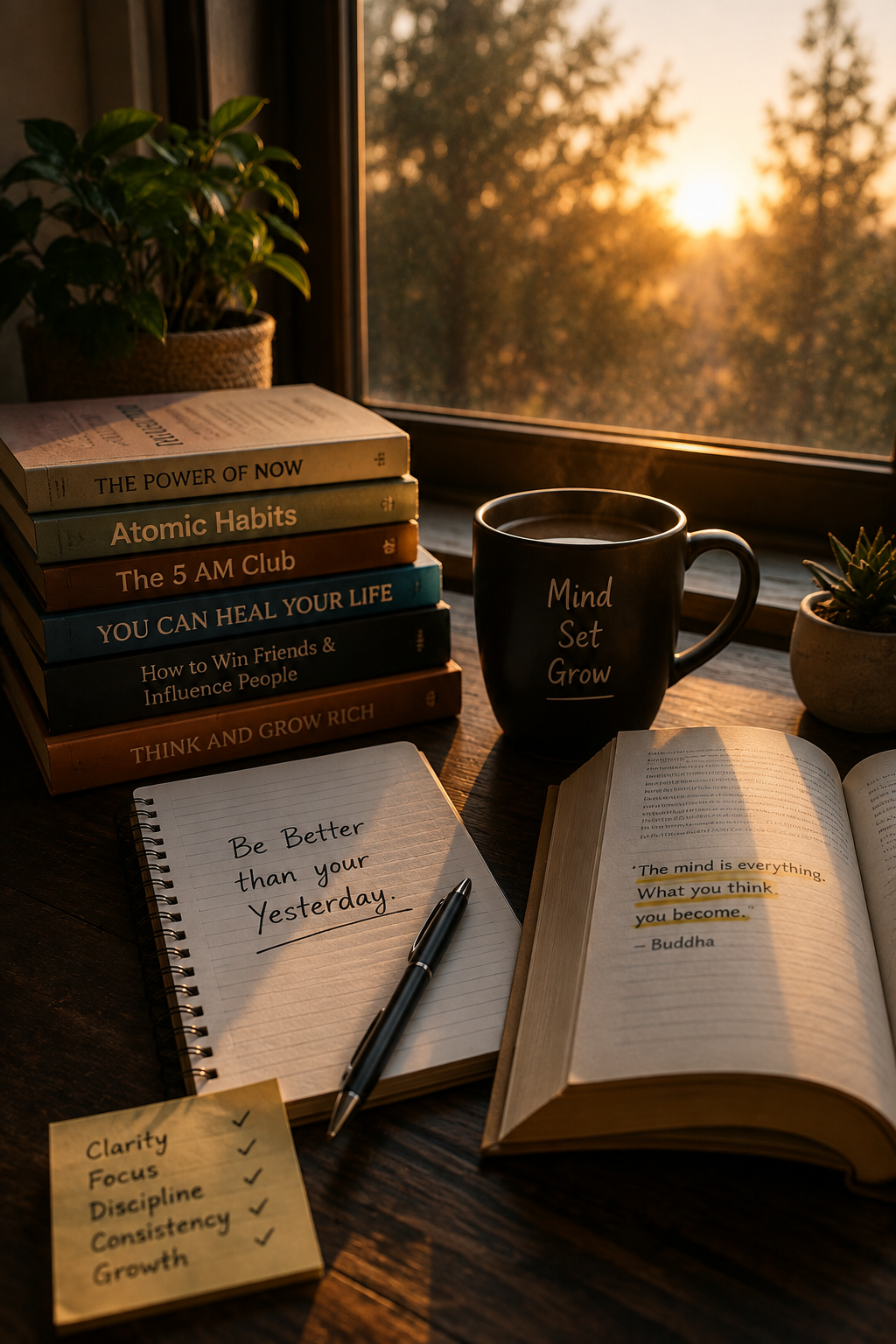
Why Self-Help Books Still Matter in a Changing World
We live in a world where almost everything is available at our fingertips.
We can learn a new skill from a video, speak to someone on the other side of the world, track our finances from a phone and find an answer to almost any question within seconds.
And yet, some of the most important questions in life remain unanswered.
How do I understand myself?
How do I deal with failure?
How do I build healthier relationships?
How do I stop repeating the same mistakes?
How do I find meaning when life doesn’t go according to plan?
This is where the enduring appeal of self-help books comes from.
They don’t necessarily give us all the answers.
Sometimes, they simply help us ask better questions.
The Search for a Better Life Is Not New
The term self-help may be modern, but the human desire to understand life is ancient.
Thinkers such as Socrates, Plato, Aristotle, Seneca, Plutarch and Marcus Aurelius spent centuries exploring questions about character, virtue, relationships, discipline, happiness and the meaning of a good life.
Their works were not “self-help books” in the modern publishing sense.
But many of the questions they explored remain remarkably familiar.
How should we respond to difficult circumstances?
What is within our control?
What makes a good life?
How should we deal with our emotions?
How do we become better human beings?
Centuries later, we are still asking many of the same questions.
Only the world around us has changed.
Our Problems Have Changed. Our Inner Questions Haven’t.
Technology has transformed the way we work, communicate and live.
But technology has not eliminated loneliness.
It has not removed uncertainty from relationships.
It has not made failure painless.
And having more information has not necessarily made us wiser.
Today, people struggle with relationships, career uncertainty, financial pressure, burnout, loneliness, self-doubt and the constant feeling that they are falling behind.
Social media can make comparison almost unavoidable.
Professional success can become an endless race.
And sometimes, despite having everything that appears “right” from the outside, a person can still feel lost on the inside.
That is why books about personal growth continue to find readers.
The circumstances may change. The human need for understanding remains.
A Good Book Can Give You a Pause
One of the most valuable things a book can offer is something our modern lives rarely provide:
a moment to stop.
We spend much of our day consuming information.
A thoughtful book asks us to slow down.
To sit with an idea.
To question an assumption.
To recognize a pattern in ourselves.
Sometimes a single paragraph can make you think:
“Maybe this is what I’ve been doing all along.”
That moment of recognition can be powerful.
Not because the book magically changed your life.
But because it helped you see your life differently.
Self-Help Is Not About Becoming Perfect
Perhaps the biggest misunderstanding about self-help is that it promises a perfect version of you.
Wake up early.
Think positively.
Work harder.
Be productive.
Achieve more.
Repeat.
But real personal growth is rarely that simple.
Sometimes growth means learning to rest.
Sometimes it means admitting that something isn’t working.
Sometimes it means setting a boundary.
Sometimes it means forgiving yourself for something you did when you didn’t know better.
And sometimes growth means asking for professional help instead of trying to solve everything alone.
Self-improvement should not become another reason to dislike yourself.
The purpose of growth is not to become someone else.
It is to understand yourself more honestly.
A Book Can Be a Mirror, Not a Medicine
A self-help book cannot replace a doctor, therapist, financial adviser, mentor or other qualified professional when you genuinely need one.
And it shouldn’t pretend to.
Books can provide perspective.
They can introduce ideas.
They can help us reflect.
They can give us practical exercises and new ways of looking at familiar problems.
But reading about change and actually changing are two different things.
A book may tell you how important boundaries are.
You still have to set one.
It may explain why procrastination happens.
You still have to begin.
It may encourage you to forgive yourself.
You still have to do the difficult emotional work.
Reading can open the door. You still have to walk through it.
Sometimes, the Right Words Arrive at the Right Time
There are moments in life when we don’t necessarily need a complicated solution.
We need perspective.
A few honest words can sometimes interrupt a cycle of negative thinking.
A story about someone who survived failure can remind us that failure isn’t the end.
A thoughtful explanation of grief can make us feel less strange for grieving.
A chapter about boundaries can help us recognize what we have been tolerating.
A personal story can quietly tell us:
“You are not the only one who has felt this way.”
That feeling of being understood can be deeply comforting.
You Are Not Alone in Your Struggle
One of the beautiful things about books is that they allow us to borrow another person’s experience.
Someone struggled before us.
Someone questioned what we are questioning.
Someone made mistakes.
Someone rebuilt their life.
Someone found a different way forward.
We may never meet that person.
Yet their words can reach us years—even centuries—later.
That is one of the quiet powers of writing.
A person’s experience can become another person’s perspective.
But Don’t Read Everything You See
The modern self-help industry is enormous.
And that comes with a problem.
Not every book is useful.
Not every motivational quote is wise.
Not every productivity method works for everyone.
Not every online coach is qualified to guide people through serious emotional or psychological difficulties.
Some advice can oversimplify complicated problems.
Some books can make people feel as though every difficulty is their personal failure.
Life is more complicated than that.
Your circumstances matter.
Your environment matters.
Your relationships matter.
Your health matters.
And sometimes, factors outside your control matter enormously.
So read critically.
Keep what genuinely helps.
Question what doesn’t.
And never feel guilty because someone else’s “perfect routine” doesn’t work for your life.
The Best Self-Help Book Is the One That Changes Something
Reading twenty books about discipline while never changing your habits may not help much.
Reading one thoughtful book and applying one meaningful idea might.
Perhaps the better question isn’t:
“How many self-help books have I read?”
It is:
“What have I actually changed because of what I read?”
Did you become more patient?
Did you communicate better?
Did you start taking care of yourself?
Did you finally set a necessary boundary?
Did you stop blaming yourself for something that wasn’t yours to carry?
Did you begin something you had been postponing?
These changes may look small.
But small changes repeated consistently can reshape a life.
Read to Understand, Not Just to Improve
There is nothing wrong with wanting to become better.
But sometimes, reading should not be another productivity task.
You don’t always have to extract five lessons from every chapter.
Sometimes you can simply sit with an idea.
Think.
Question.
Reflect.
And allow it to change you slowly.
Because personal growth isn’t always dramatic.
Sometimes it is almost invisible.
You become a little more aware.
A little more patient.
A little less reactive.
A little kinder to yourself.
And one day you realize that the person you are today would have handled yesterday’s problems differently.
That is growth too.
Start With the Question You Are Actually Living
You don’t need to read every self-help book ever written.
Start with what is real in your life right now.
If you are struggling with relationships, read about communication and boundaries.
If you are questioning your direction, explore books about purpose and meaning.
If you are struggling with habits, learn about behaviour and consistency.
If you are dealing with grief or emotional pain, look for thoughtful, evidence-informed resources—and seek professional support when you need it.
If you are simply curious about becoming a better version of yourself, start there.
Choose books that challenge you without making you feel broken.
Choose writers who respect complexity.
Choose ideas that encourage reflection rather than blind obedience.
In the End, a Book Can Only Point the Way
A self-help book cannot live your life for you.
It cannot make your difficult conversation.
It cannot apply for the job.
It cannot repair the relationship.
It cannot make the decision.
It cannot take the first step.
You have to do those things.
But a good book can sit beside you while you are trying to figure them out.
It can give you language for something you couldn’t explain.
It can introduce you to an idea you had never considered.
It can remind you that your current chapter is not necessarily your final one.
And sometimes, that is enough to begin.
So read.
Read slowly.
Question what you read.
Apply what genuinely helps.
And leave behind what doesn’t.
Because the real value of self-help isn’t becoming a flawless human being.
It is becoming a little more conscious of the life you are already living—and a little more intentional about the life you want to create.